
One question comes up again and again from YouTube.
What is the outlook for BIM engineers?
I made a video about BIM engineer salaries three years ago.
Then came COVID, ChatGPT, and a flood of generative AI. We are living in a time when no one can predict the future easily. Many people are afraid and unsure about the path ahead. That is probably why people still email me, hoping for any kind of hold. I am sorry I have not been able to answer each one.
I cannot claim to predict the future either, but with the mood I see at work and some help from Bing, I want to make a careful guess about the years ahead.
Shall we look at it together?
The short version: I still expect BIM engineer to be a promising role through 2030.
Here is why.
1. BIM is the best-known tool in virtual construction.
BIM (Building Information Modeling) lets you build a structure first in a virtual environment and find problems early. Rework from mistakes or wrong construction is estimated at almost 30% of project cost. Fixing just that part would already have a huge effect. Thirty percent. Can you believe that?
2. Search interest in BIM keeps rising.
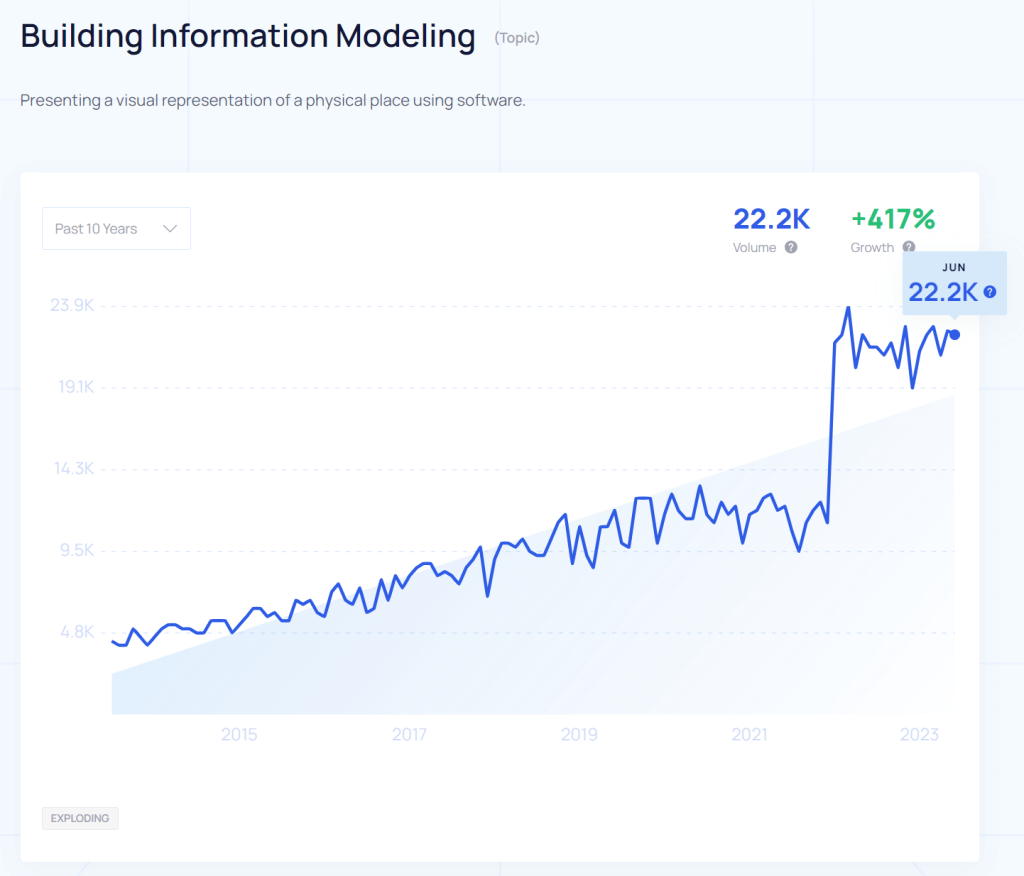
Searches for Building Information Modeling have risen 417% over the last ten years (as of July 2023).
The BIM market has also kept growing and, as of 2023, is worth 800 million dollars.
The NBS 2020 BIM Report said 73% were using BIM as of 2020. In 2011 almost half of NBS respondents had never even heard of BIM. That is a large change.
3. It is expanding beyond BIM into digital engineering.
Digital engineering in construction applies digital tools and methods to the design, delivery, and operation of built assets. It is not only BIM data. 3D printing, VR, AR, AI, machine learning, IoT, cloud computing, big data, and blockchain are combined to build a digital twin. That can be used for simulation, testing, monitoring, and maintenance.
Closing
From the above, BIM is clearly one of the hotter technologies in construction. From the field, construction is still far slower to adopt technology than other industries. BIM itself also spread more slowly than early forecasts, because of cost and a lack of people. Recently, though, it feels like the pace has picked up. There are not many places left that have never heard of BIM. COVID may have played a part.
In short, demand for BIM engineers is likely to keep growing through 2030. Because the tools are changing fast, you still have to keep up with new methods and the changing needs of the market.
Does that make you more interested in the role, or more afraid?
Drop a comment. I want to hear what you think. This is HowBIM.
Notes.
11 Construction Industry Trends to Watch (2023-2026)
#BIM, #HOWBIM, #BIM engineer, #BIM outlook, #digital twin, #digital engineering